Visual Project · Print On Paper, 2025
Love Letter to My Non-Existing Boyfriend in Prison
A project by Tata Potskhverashvili
What happens when political repression enters the imagination of ordinary intimacy?
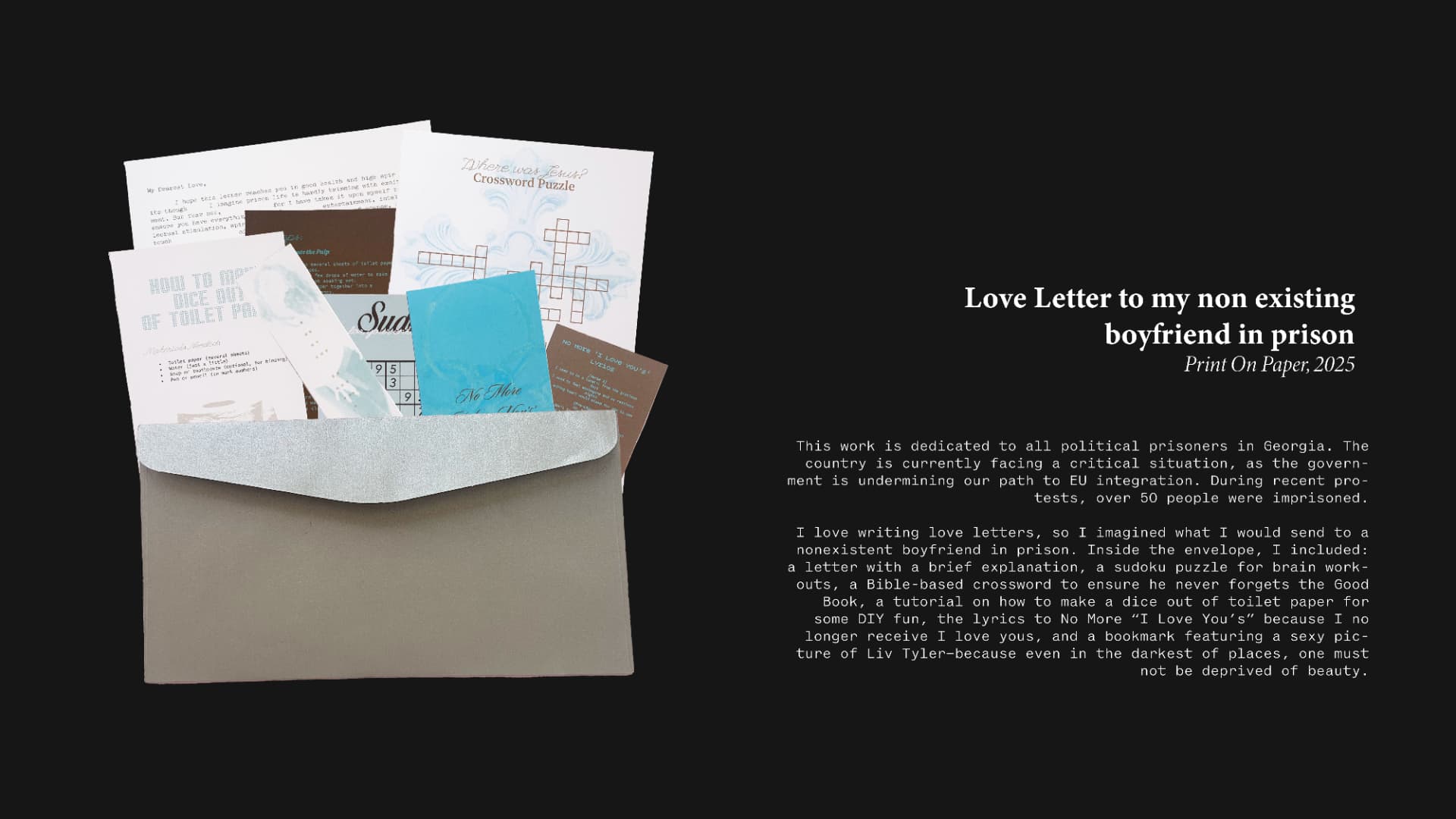
There is something unsettling about imagining a lover in prison before that lover exists.
Love Letter to My Non-Existing Boyfriend in Prison is a project created by graphic designer Tata Potskhverashvili in Georgia at a moment when imprisonment has become an increasingly imaginable consequence of political participation. Since the protest movement that intensified in late 2024, Georgian authorities have expanded restrictions on assembly and detained protesters, activists, journalists and opposition figures. The hypothetical situation on which the work depends sits strangely between fiction and anticipation. The artist does not have a boyfriend in prison, but she inhabits a political reality in which having someone you love detained for protesting no longer belongs comfortably to the realm of the improbable.
Imagining the prisoner
We usually think of political imprisonment through the person who is imprisoned: the protester, activist, dissident or opposition figure. The prisoner's body becomes the obvious site of state power. It is the body that can be arrested, searched, confined, watched and prevented from moving.
But incarceration reorganizes relationships beyond the prison walls as well. It produces people who wait, visit, send money, make phone calls, collect documents, worry, remember and write. Anthropological work on incarceration has therefore increasingly approached imprisonment not simply as something that happens to an isolated individual, but as something that rearranges kinship and intimacy. Orisanmi Burton, for instance, describes letter writing within carceral life as both a form of care and a political practice, precisely because incarceration attempts to rupture social relations while correspondence continually tries to remake them.
The imagined boyfriend in this project is therefore accompanied by another imagined figure: the person waiting outside.
By constructing the envelope, the artist rehearses that position. She imagines herself not as the political prisoner but as the person responsible for maintaining a small thread between prison and ordinary life. What would he be bored by? What would make him laugh? What would occupy twenty minutes of an afternoon? What could he make with the materials available to him? What might he want to look at? What would remind him that somebody outside is thinking about him?
These are strikingly mundane questions. And that mundanity is important.
Political repression is often represented through exceptional images: police lines, courtrooms, demonstrations, prison cells. This project approaches it through something much less spectacular — the problem of how to care for someone whose everyday life has suddenly been taken away from them.
What fits inside an envelope?
The envelope is almost a miniature world.
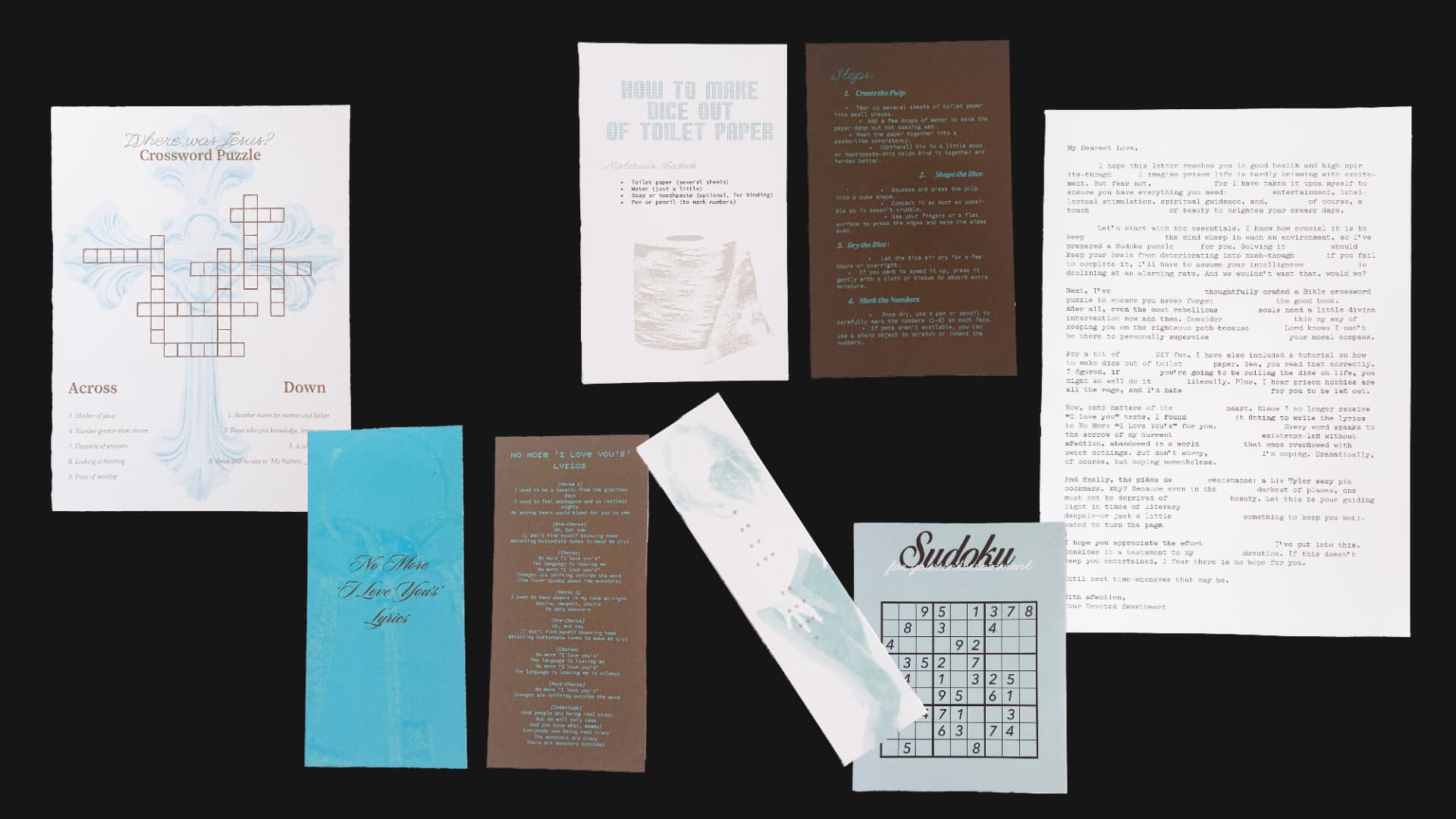
There is something to read, something to solve, something to make, something beautiful to look at, something ridiculous, something romantic. Each item responds to a different deprivation.
The sudoku and crossword address boredom and time. The toilet-paper dice produce the possibility of play. The song lyrics bring music into a space where the actual song may be inaccessible. The bookmark imagines reading and therefore continuity: there will be another page tomorrow. The photograph introduces beauty and desire. And the love letter does perhaps the simplest and most important thing — it addresses the prisoner as a person who is loved rather than merely as an inmate.
Seen this way, the collection is not random at all. It is a small architecture of ordinary life.
Prison works partly through restriction: of movement, objects, privacy, communication and choice. The package answers those restrictions with extremely modest acts of invention. A sheet of toilet paper can become dice. Printed words can stand in for a song. A photograph can become company. A puzzle can turn an hour that must simply be endured into an hour with a task.
None of these objects can undo imprisonment. Their significance lies precisely in their inadequacy. They are tiny things placed against an enormous political structure.
Anthropologist Angela Garcia's work on prison correspondence is useful here. Writing about an archive of letters exchanged across generations, she argues that prison letters cannot be understood only for the information written inside them. Their power also comes from their existence as objects: things that travel, are folded, handled, opened, kept and reread. They carry relationships materially across enforced separation.
The envelope in this project operates similarly. Its contents are not simply messages about affection. They are attempts to make affection material.
Love under political conditions
The title makes an unusual choice. It does not say Package for a Political Prisoner or Objects for the Detained. It says boyfriend.
That word changes the scale of the work. A political prisoner belongs to public language. A boyfriend belongs to private language. Putting the two together collapses a distinction that authoritarian power often depends upon: the idea that politics happens somewhere outside ordinary life.
Here, politics has already entered the bedroom, the relationship, the love letter and the private imagination. The artist is imagining not simply whom she might love but what might happen to the person she loves because of the country they inhabit.
The fictional romance consequently becomes a way of registering political atmosphere.
Fear does not always take the form of explicitly thinking, I am afraid of the state. It can appear much more quietly. It changes what futures seem plausible. People begin imagining arrests before they happen, learning prison rules they never expected to know, following court cases involving strangers, knowing what can be brought to detention, wondering what they would do if someone close to them disappeared behind a prison door.
The imagined boyfriend is compelling precisely because he has no face. He could be someone. The fiction leaves an empty space into which reality can enter.
And this is where the humor of the work matters. The toilet-paper dice, the Liv Tyler bookmark, the declaration that one must not be deprived of beauty even in prison — these details prevent the prisoner from becoming only a political symbol. He remains someone who might be bored, horny, amused, frustrated, sentimental or in need of something stupid to do.
There is something quietly resistant about this insistence.
Systems of incarceration turn people into categories: defendant, detainee, inmate, case number, offender. Intimacy stubbornly returns specificity. Did you finish the crossword? Did the dice work? Here are the lyrics you like. I thought you might find this beautiful.
Love speaks about the same person in another vocabulary.
The politics of the hypothetical
Perhaps the most disturbing word in the entire project is therefore not prison, but imagined.
Normally, imagining a hypothetical boyfriend is a harmless fantasy. What would he look like? What music would he listen to? Where would you travel together? Here the fantasy begins somewhere else: what would I send him if the state imprisoned him?
The work captures a particular psychological condition of living through political instability: extraordinary events gradually enter the repertoire of ordinary possibilities.
And yet the project refuses to allow anticipation to become only fear. Instead, the artist answers the imagined prison with preparation, humor and care. She cannot imagine herself opening the cell, so she imagines what might pass through its boundaries.
A letter.
A game.
A face.
A song without sound.
Something handmade.
Something unnecessary.
Perhaps this is why the envelope is such an effective form for the work. It acknowledges separation while simultaneously refusing complete separation. An envelope exists because two people are apart. But it also exists because that distance can still, however imperfectly, be crossed.
In a political moment when the state attempts to determine who may occupy public space, who may protest and what consequences dissent may carry, the project turns toward a much smaller territory: the intimate space between two people. Recent documentation of Georgia's protest restrictions makes the imagined scenario painfully close to contemporary life; peaceful participation in demonstrations has increasingly exposed people to detention and prosecution.
The work does not propose that affection defeats political repression. That would make love sentimental and politics simple. Instead, it asks a more modest and perhaps more difficult question:
What can care still do when it cannot change the conditions it is responding to?
Sometimes, apparently, it can do very little.
It can fold itself into an envelope.
And send whatever will fit.